
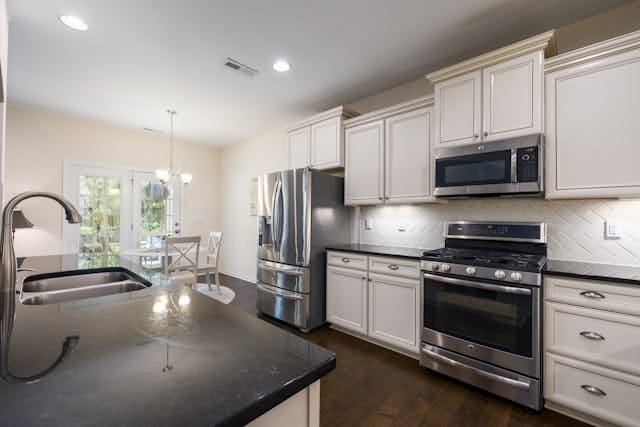
Minimalist kitchens are centered on:
- Efficiency
- Clarity
- A purposeful design.
All features must have their purpose. Unwanted details are eliminated to provide a practical area.
Below is a detailed look at these design elements.
Table of Contents
Use Straight Lines and Minimal Shapes
A minimalist kitchen is based on simple geometry. The goal is to create a streamlined look. Designers achieve this through:
- Flat-panel cabinet doors
- Designs with no handles
- Smooth surfaces.
Do not over-decorate. Avoid elaborate mouldings or ornamental trims.
The cabinets should have straight edges and equal spacing between the elements. This contributes to the visual order. It makes the kitchen seem less cluttered.
Include Embedded Storage Options
The storage must be effective. But it should not be noticeable. Concealed storage helps to keep the environment tidy.
Consider features such as:
- Push-to-open cabinets
- Built-in appliances
- Hidden drawers.
This enables the storage of items without interfering with the overall design. Minimalist designs also feature:
- Appliance garages
- Built-in compartments.
These features ensure that commonly used items are always available and the exterior is clean.
Focus on Efficient Cabinetry
Minimalist cabinetry must utilize space to the maximum. But without complicating the design. You may enhance accessibility and organizationwith:
- Deep drawers
- Pull-out shelves
- Vertical dividers.
Rather than having several small cabinets, have fewer larger cabinets. This minimizes visual interruptions. Many designers source wholesale custom cabinets to execute this design.
Work With a Limited Color Palette
Use only a few colors. This ensures consistency. Go for neutral colors like:
- White
- Gray
- Beige
- Dull earth tones
- Cream.
These colors work because they reflect light. This helps to establish a calm mood.
You can add a gentle contrast with materials or finishes. As opposed to striking color transitions.
Also, ensure uniformity in:
- Cabinets
- Walls
- Surfaces.
This will make the space feel unified.
Choose Materials Intentionally
The material must be durable. This means they should be easy to work with.
Matte finishes are commonin minimalist designs. This is due to their ability to minimize glare. They also conceal fingerprints.
Avoid over-reflective and patterned surfaces. These may cause visual noise.
Maximize Light to Bring Out Clarity
The lighting must be functional. It should emphasize the simplicity of design. Add under-cabinet lighting. It enhances the visibility of tasks and still has a clean appearance.
Avoid large fixtures. Instead, use recessed ceiling lights. They ensure that the visual field is not cluttered.
Get Rid of Needless Things
Minimalism is about control over what is in your sight. Keep very few items on countertops. Store the rest of the stuff out of sight.
This is not only about enhancing the appearance. It is also about simplifying cleaning and maintenance.
Concluding Thoughts
A minimalistic kitchen succeeds when each element is purposeful:
- Clean lines
- Hidden storage
- Efficient cabinetry.
These elements combine to produce a practical and visually controlled space.